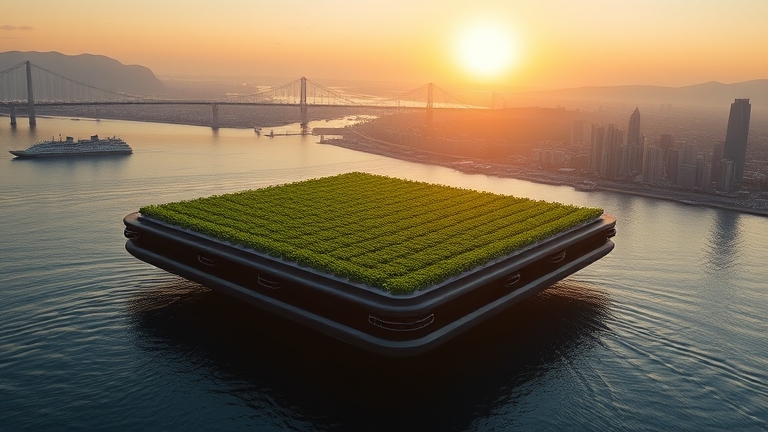
At a ceremony in Rotterdam on June 5, the SkyHarvest Initiative—a partnership of the United Nations Food and Agriculture Organization, the European Union, and three leading green-tech firms—unveiled the first generation of autonomous floating farms designed to grow vegetables, legumes, and algae on the open water surrounding megacities.
“We are turning the ocean’s surface into a sustainable pantry,” said Dr. Lina Alvarez, FAO’s Director of Innovation, referencing the pilot platform that can produce 1.2 million kilograms of edible biomass per year, enough to feed roughly 250,000 people.
The floating farms are powered by a hybrid of solar panels and wave‑energy converters, enabling a 98% reduction in carbon emissions compared with traditional land‑based greenhouse operations. According to a joint study released by the initiative, the technology can boost yields by 30% while using 70% less freshwater, thanks to closed‑loop hydroponic systems and seawater desalination modules.
“Our AI‑driven control system constantly adjusts nutrient flow, light exposure, and harvest cycles,” explained Maya Chen, CEO of AquaGrow, one of the commercial partners. “In simulations, we’ve seen a 15‑day reduction in crop turnaround, which translates to faster response to market spikes and climate shocks.”
Early adopters in Lagos, Jakarta, and Rio de Janeiro are already testing the platforms. Local farmer and community leader Adewale Okonkwo reported that the pilot in Lagos has cut food imports by 12% and created 450 jobs for youth trained in marine agronomy.
World Bank data projects that by 2035, coastal populations will exceed 3.5 billion, intensifying pressure on land resources. SkyHarvest’s founders argue that water‑based agriculture could supply up to 10% of global vegetable demand by 2040, a claim supported by the International Renewable Energy Agency’s forecast that marine‑farm capacity could reach 2 million hectares within the next decade.
Critics caution that scaling the technology will require robust regulatory frameworks to prevent habitat disruption. “We must ensure that floating farms coexist with marine ecosystems, not replace them,” warned Dr. Samuel Ortiz of the Marine Conservation Institute. The initiative has pledged to allocate 15% of each farm’s footprint to native seaweed and oyster beds to enhance biodiversity.
As the first platforms drift into the harbor, the world watches whether SkyHarvest can deliver on its promise of a resilient, sea‑borne food supply—an answer to rising climate risks and urban hunger.