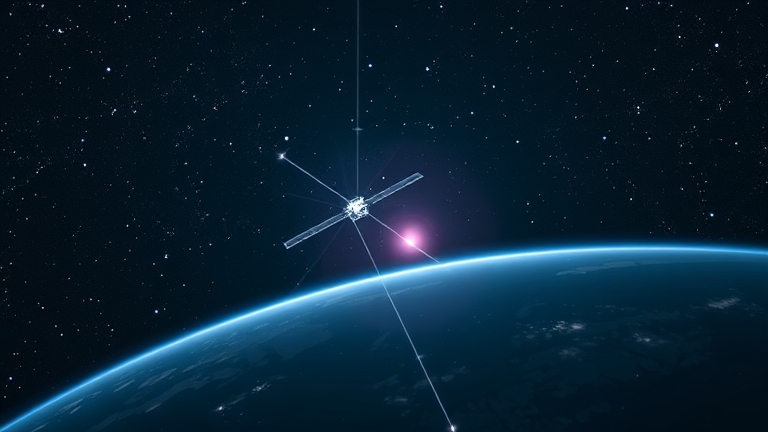
On June 5, 2026, a coalition of European Union members and Japanese aerospace firms activated the first commercial quantum‑secure satellite network, a system that uses quantum entanglement to encrypt data in real time. The eight‑satellite constellation, positioned in low‑Earth orbit at roughly 1,200 km altitude, now provides continuous coverage over Europe, East Asia, and major trans‑Atlantic corridors.
The technology relies on photon‑pair generation aboard each satellite, creating entangled keys that are refreshed every two seconds. According to the consortium’s technical white paper, the network achieves a 99.9 % uptime and latency as low as 15 ms, rivaling conventional fiber‑optic links while delivering what researchers call “theoretically unbreakable” encryption.
Financial analysts estimate that the system could secure up to $2.3 trillion of cross‑border transactions each year, spanning banking, supply‑chain logistics, and governmental communications. A recent study by the Global Cyber Institute projects a 30 % reduction in cyber‑incident costs for firms that adopt the service, translating to annual savings of roughly $150 billion worldwide.
“This is a watershed moment for digital resilience,” said Elisa Marquez, head of the EU’s Digital Resilience Directorate. “Our markets will finally have a security foundation that matches the speed and volume of modern data flows.” Hiroshi Tanaka, director of Japan’s Ministry of Economy, Trade and Industry Quantum Initiative, added, “The partnership demonstrates Japan’s commitment to quantum technologies and our belief that secure connectivity is a public good.”
Industry experts caution that the rollout will face hurdles, including the need for ground‑station upgrades and regulatory harmonisation across jurisdictions. Dr. Aisha Patel, senior fellow at the Global Cyber Institute, warned, “The quantum link is only as strong as the weakest node in the network. Coordinated policy and investment are essential to prevent fragmented security standards.”
Nonetheless, the launch has spurred interest from the United States, Canada, and South Korea, all of which have announced exploratory missions to develop compatible quantum‑satellite architectures. If these efforts coalesce, the next decade could see a global lattice of quantum‑secure links, fundamentally reshaping how governments and corporations protect their most sensitive data.